
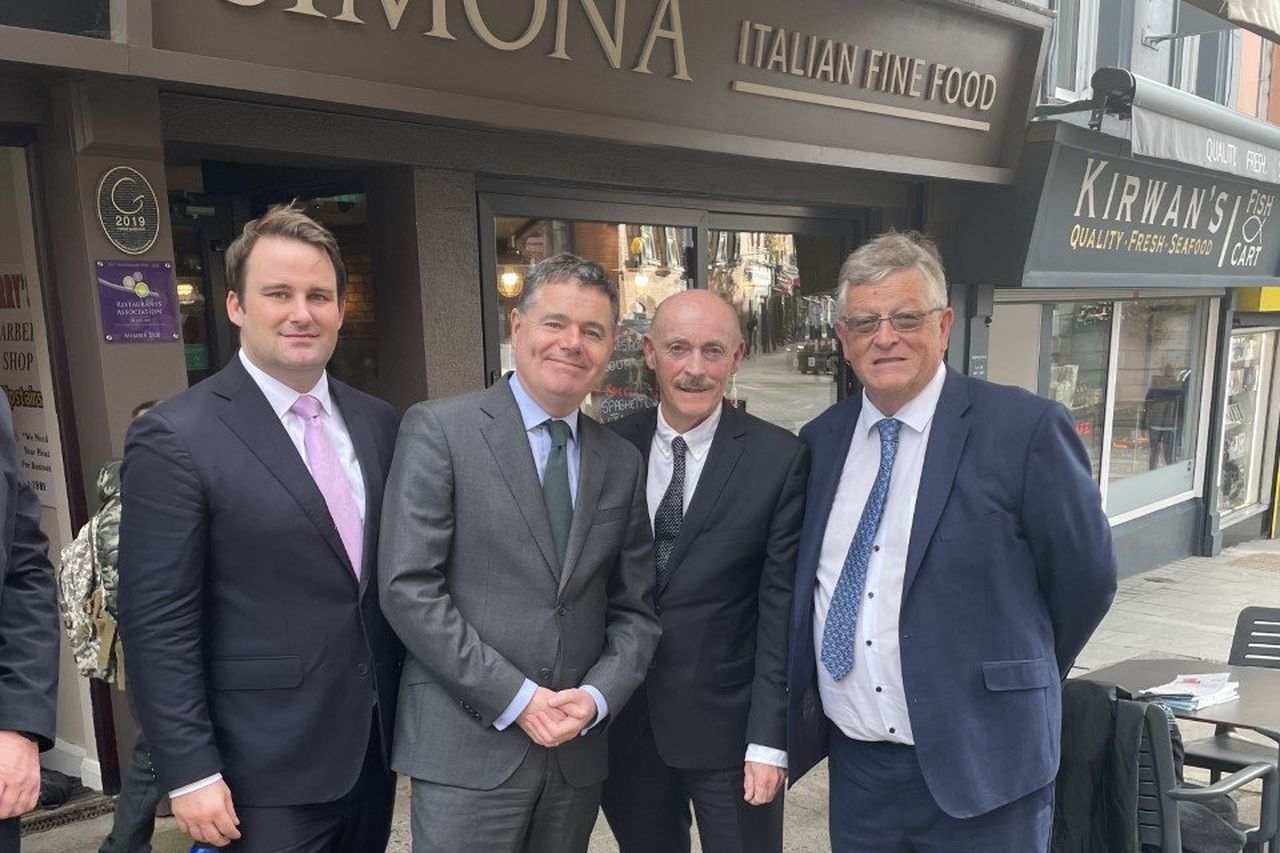
In October 2025, I attended the Dundalk Chamber Budget Breakfast briefing alongside over 200 local business owners and professionals. Colin Spence from EY presented the key measures in detail, and in the weeks since I’ve been working through the implications with clients across County Louth.
The headline from Budget 2026, for most Dundalk SMEs, is this: there are some genuinely useful measures — particularly for employers, for town-centre property investors, and for early-stage businesses — but the level of ambition on the structural issues facing Irish SMEs fell short of what the business community had been lobbying for.
Here’s what matters and what it means in practice.
The Living City Initiative — Dundalk Is In
I’ve written a separate, detailed piece on this, but it deserves mention here because it was one of the most significant wins for Dundalk in this Budget. After more than a decade of pre-budget submissions from Dundalk Chamber — in which I was directly involved — Dundalk was finally added to the Living City Initiative in Budget 2026.
The scheme provides income tax relief for individuals who refurbish qualifying residential buildings in the town centre for use as their principal private residence, and accelerated capital allowances for businesses that invest in qualifying commercial properties in the designated area. It is a meaningful incentive for town-centre investment and, used correctly, a substantial tax saving.
If you are a property owner, business owner, or investor with an interest in Dundalk town centre, this is worth investigating in detail.
The Shop Local Voucher — Better Than Before
The Small Benefit Exemption scheme — colloquially known as the Shop Local voucher scheme — received two positive adjustments in Budget 2026 that make it more useful for employers than it has ever been.
Previously, the exemption allowed employers to give employees up to two non-cash benefits per year, with a maximum annual value of €1,000, without triggering PAYE or PRSI. Budget 2026 increased the frequency to five benefits per year and raised the maximum annual amount to €1,500.
In practice, this means a Dundalk employer can now give each employee up to €1,500 in vouchers or non-cash benefits per year, completely free of income tax, USC, and PRSI for both parties. For a business with ten employees, that’s up to €15,000 in effectively tax-free compensation per year — money that goes directly into the pockets of employees and circulates in the local economy.
The timing flexibility — five occasions rather than two — also makes this easier to use as part of a broader employee recognition or retention strategy. A €300 voucher at Christmas, a €300 voucher in summer, and three further €300 payments at other points in the year is a genuinely valuable addition to an employment package.
If you are not using this scheme in full, you are leaving money on the table — it is one of several reliefs I cover in our guide to the ten tax reliefs Irish business owners regularly miss.
Angel Investor Relief — A New CGT Incentive for Startup Investors
For business owners and investors with an interest in early-stage companies, Budget 2026 introduced the Angel Investor Relief — a new Capital Gains Tax incentive that significantly reduces the tax cost of investing in qualifying innovative startups.
Under the relief, individual investors who acquire shares in qualifying early-stage SMEs can, when they eventually sell those shares, pay CGT at a reduced rate of 16% rather than the standard 33%. The reduced rate is available on a gain up to a maximum of twice the original investment. Investments made through a qualifying partnership are eligible at a slightly higher rate of 18%.
This is a form of permissible State aid under the EU’s General Block Exemption Regulation and is designed specifically to address the funding challenges facing early-stage innovative businesses in Ireland — where access to equity capital has historically been more difficult than in the UK or US.
For Dundalk businesses with innovation credentials — tech-enabled services, advanced manufacturing, digital products — this relief opens up a new avenue for attracting investment from sophisticated individual investors who might previously have been deterred by the CGT exposure.
EIIS — Improvements Confirmed
The Employment Investment Incentive Scheme (EIIS) — which allows individual investors to claim income tax relief on investments in qualifying Irish companies — also received improvements in Budget 2026. The changes strengthen the scheme’s accessibility and increase the amounts that can qualify.
EIIS has been consistently underused by Irish SMEs relative to its potential, partly because the administrative requirements have historically been onerous. The Budget 2026 changes represent a genuine improvement. If you are looking for equity investment in your business, or if you are a higher-rate taxpayer looking for a legitimate tax-efficient investment vehicle, EIIS is worth examining carefully.
What Wasn’t In Budget 2026 — And What Dundalk Chamber Had Asked For
To give an accurate picture, it would be misleading to focus only on the wins. There were several measures that Dundalk Chamber had lobbied for that were not delivered.
Cross-border relief — a specific provision to address the additional complexity faced by businesses operating across the NI–ROI border — was sought in the Chamber’s pre-budget submission and was not included. This remains a gap, particularly as cross-border employment becomes more complex post-Brexit.
Capital Gains Tax reform — the Chamber had advocated for a reduction in the standard CGT rate of 33% to encourage business investment and disposal of assets, as outlined in our guide to how CGT works for Irish SMEs. No reduction was made.
Inheritance tax threshold improvements — while some adjustment was made to thresholds in Budget 2025, the overall level remains a significant concern for family businesses planning succession. This remains on the Chamber’s agenda for future years.
Preparing for Auto-Enrolment — The Payroll Story of 2026
While technically arising from legislation passed in 2024 rather than Budget 2026 directly, the auto-enrolment pension system that came into effect in September 2025 is the payroll story of the year for Dundalk employers. The additional employer contribution of 1.5% of salary (rising over time to 6%) needs to be factored into payroll budgets. I’ve written a separate, detailed guide to auto-enrolment which I would encourage every employer to read.
The Bottom Line for Dundalk SMEs
Budget 2026 was, broadly, a holding Budget for small businesses. The measures on Shop Local vouchers, the Living City Initiative, and the Angel Investor Relief are genuinely useful. The bigger structural asks — cross-border relief, CGT reform — remain for future years.
The businesses that will benefit most from this Budget are those that are actively planning — using the reliefs that are available rather than leaving them unclaimed. You can find all of our Budget analysis and tax planning articles in our taxation guides. If you haven’t reviewed your use of the Small Benefit Exemption, explored the Living City Initiative for your property interests, or considered whether EIIS or Angel Investor Relief might be relevant to your business, now is the time.
Paddy Malone FCA AITI
Paddy is the principal of Malone & Co. Chartered Accountants in Dundalk. A Fellow of Chartered Accountants Ireland and a Chartered Tax Consultant with the Irish Tax Institute, he has been advising businesses across County Louth and the North-East for over 35 years.