
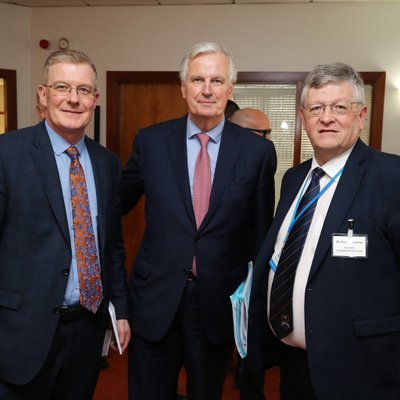
The annual Cross-Border Conference organised by Dundalk Chamber of Commerce and Newry Chamber of Commerce brings together business leaders, policy makers, and public representatives from across the Drogheda–Dundalk–Newry corridor. It is one of the most substantive gatherings of cross-border business thinking on the island — attended by over 200 representatives from organisations on both sides of the border, it reflects the genuine commercial interdependence of this region.
I have been involved with Dundalk Chamber for many years — our article on Dundalk Chamber’s 75 years of business advocacy covers the full scope of that work — and have participated in or contributed to these events throughout their history. The themes that emerge from cross-border business conversations in the corridor tell us a great deal about what the region’s businesses are actually grappling with — and they inform the kind of advice and support that is most relevant for businesses operating here.
The Dominant Theme: Complexity Has Increased, Not Decreased
The Brexit optimists argued that post-transition arrangements would eventually settle into a new normal that businesses would adapt to efficiently. Five years on, the honest assessment from the business community is more complicated. Some aspects have settled — customs documentation, for example, has become routine for businesses that were not previously importing or exporting. But other dimensions of cross-border commercial life have become demonstrably more complex.
Employment is the clearest example. Businesses that had cross-border employment arrangements in place before 2020 — arrangements that were relatively straightforward under the free movement framework — have found that the combination of Brexit and post-pandemic remote working has created a compliance landscape that many of them have not fully assessed.
The cross-border employment tax breakfast that Dundalk Chamber organised in partnership with the Cross-Border Partnership Employment Services drew nearly 100 employers. The topics addressed — contractor versus employee status, remote working tax implications, dual payroll, social security, auto-enrolment, and gender pay gap reporting — reflected real and pressing issues for businesses in the corridor. These are not abstract policy concerns. They are compliance obligations that cost money if ignored.
US Tariffs and the Export-Oriented Corridor
In early 2026, a new source of uncertainty emerged for export-oriented businesses on both sides of the border: the reintroduction and escalation of US tariffs on a range of goods, with particular implications for Irish agri-food and manufacturing exporters.
The M1 Corridor has significant agri-food processing capacity. County Louth’s food and drink sector, including several significant processing operations, has direct exposure to transatlantic trade policy. The Government of Ireland’s Action Plan to Support Market Diversification — welcomed by Chartered Accountants Ireland and others — acknowledges the scale of the challenge but has also underscored the urgency of businesses reducing single-market dependencies where possible.
For corridor businesses with US export exposure, the practical response involves a combination of market diversification (developing alternative markets, particularly within the EU and in Asia-Pacific), supply chain review, and attention to the evolving tariff schedule to understand exactly which goods are affected and at what rate.
This is an area where good financial advice — understanding the cashflow implications, the pricing adjustments required, and the investment case for market development — is directly relevant to business survival.
Infrastructure: Progress and Persistent Gaps
Every cross-border business conversation returns to infrastructure. The M1 Corridor’s growth potential is real but constrained by specific bottlenecks that have been identified and articulated in multiple submissions to government.
Water and wastewater capacity in Dundalk is the most frequently cited constraint, a topic we explore in depth in our article on Dundalk’s water infrastructure gap. The Dundalk Wastewater Treatment Plant upgrade — long sought by the Chamber and supported by Uisce Éireann’s planning submissions — is essential to unlock the scale of residential and commercial development the corridor’s growth projections require. Progress is being made, but the timeline remains a source of frustration for developers and businesses looking to expand.
Transport connectivity is the other perennial theme. The Dublin–Belfast Enterprise rail service matters to the corridor in a way that it does not matter to most Irish regions — it is a genuine cross-border infrastructure asset. Improving journey times and service frequency is not just a convenience issue; it is a competitiveness issue for corridor businesses trying to attract talent that would otherwise default to Dublin.
The National Development Plan 2040’s recognition of the Drogheda–Dundalk–Newry corridor as a primary growth centre provides the policy framework for these investments. The practical challenge is converting policy intent into funded projects and physical infrastructure on the ground.
What the Business Community Is Asking For
From conversations at Chamber events, submissions to government, and direct engagement with businesses across the corridor, the priorities that come through consistently are:
Cross-border employment relief. A specific legislative measure that acknowledges the complexity of employment across the Irish border post-Brexit and provides practical relief for businesses managing it. Dundalk Chamber has been advocating for this in budget submissions.
Infrastructure investment. Particularly water and wastewater in Dundalk, and improved rail connectivity along the corridor.
More flexible planning and housing. The constraints on housing supply are limiting the corridor’s ability to attract and retain the workforce its growth ambitions require.
Practical support for businesses navigating US tariff uncertainty. Access to advisory resources, market development support, and financing flexibility for businesses affected by trade policy changes.
Better cross-border signage and profiling. The corridor has a compelling story — a “Linear City” with 2.25 million people within an hour’s drive, served by two international airports, with a cross-border workforce and NDP strategic status. This story is not being told as effectively as it could be to potential investors and businesses considering location decisions.
What This Means for Businesses in the Corridor
If you are a business based in Dundalk or the wider County Louth area, the cross-border dimension of your commercial environment is not optional context — it is central to where you operate, who you employ, what regulations apply to you, and what opportunities are available to you.
The businesses that navigate this environment best are the ones that take it seriously: that have properly assessed their cross-border employment arrangements, that are engaging with the LEO and InterTradeIreland on the support available, that are watching the tariff situation and thinking about diversification, and that are connected to the Chamber and other business networks that are actively representing the region’s interests.
The corridor’s trajectory is positive. The NDP recognition, the Living City Initiative, the scale of the catchment — these are genuine advantages that we examine across our Dundalk economy guides. Realising them requires businesses and institutions to act on the opportunity, not just acknowledge it.
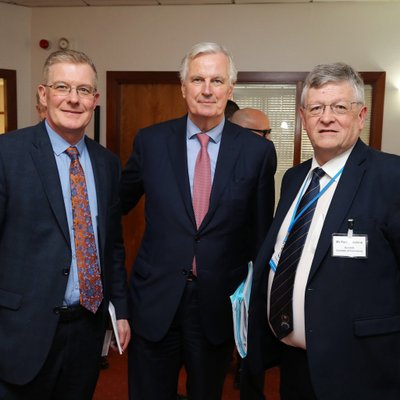
Paddy Malone FCA AITI
Paddy is the principal of Malone & Co. Chartered Accountants in Dundalk. A Fellow of Chartered Accountants Ireland and a Chartered Tax Consultant with the Irish Tax Institute, he has been advising businesses across County Louth and the North-East for over 35 years.