
For a Dundalk business looking at the Northern Ireland market — a population of nearly two million people, a short drive up the M1, sharing a language and much of a culture — the natural question is: how do we structure this properly?
The answer is not straightforward, and it has changed since Brexit — as I assess in my article on what Brexit has actually changed for Dundalk businesses five years on. What was once a relatively frictionless cross-border business environment, governed by consistent EU rules on VAT, employment, and company law, is now a more complex dual-jurisdiction landscape where the decisions made at the outset have lasting consequences.
This article covers the main structural options for a Republic of Ireland business expanding into Northern Ireland (or vice versa), the tax and regulatory implications of each, and the key decisions that need to be made before you start operating. It is part of our full series of cross-border business guides covering VAT, employment, payroll, and structuring for corridor businesses.
Option 1: Single ROI Company Trading Into NI
The simplest approach, on paper, is to operate from your existing Republic of Ireland company and simply start selling to customers in Northern Ireland. No new entity, no new registration — just new customers.
This works well for businesses that are primarily selling goods or services into Northern Ireland without establishing any physical presence there. A Dundalk consultancy that takes on Northern Ireland clients, or a manufacturer that exports products across the border, can often operate under this model with relatively modest additional complexity.
The tax position: if the ROI company is trading into Northern Ireland but has no Northern Ireland presence — no office, no employees based there, no stock held there, no agent habitually concluding contracts on its behalf in NI — it is unlikely to have a UK corporation tax exposure. Trading with a market is different from trading in a market.
The VAT position post-Brexit is more complex. Northern Ireland has a unique status under the Windsor Framework — it is part of the UK for customs and direct tax purposes, but follows EU VAT rules for goods (making it effectively still part of the EU VAT area for goods transactions). For services, Northern Ireland follows UK VAT rules. This dual-system VAT treatment of Northern Ireland is genuinely confusing and is the source of a significant proportion of cross-border compliance errors. I have covered this in detail in my practical guide to cross-border VAT under the Windsor Framework.
Option 2: ROI Company With a UK Branch
A Republic of Ireland company can establish a branch in Northern Ireland. The branch is not a separate legal entity — it is an extension of the ROI company, operating under the same legal identity in Northern Ireland.
Registering a ROI company branch in Northern Ireland requires filing at Companies House in the UK (analogous to the CRO in Ireland). The branch must maintain its own accounting records for UK purposes, and the ROI company will have a UK corporation tax filing obligation on any profits attributable to the UK branch activity.
UK corporation tax is currently 25% for larger companies and 19% for companies with profits below £50,000 (with marginal relief between those levels). This compares to 12.5% in the Republic of Ireland for trading income, making the Irish rate significantly more competitive for pure tax purposes.
The branch structure makes sense where the Northern Ireland activity is an extension of the ROI business rather than a genuinely separate business, and where the administrative overhead of a separate NI company is not justified.
Option 3: Separate Northern Ireland Incorporated Entity
The cleanest and most flexible structure — but also the most administratively demanding — is to incorporate a separate legal entity in Northern Ireland, typically a private limited company under the Companies Act 2006 (UK).
The NI company and the ROI company are legally separate entities under their respective company laws. Each files accounts, pays taxes, and manages employment under its own jurisdiction’s rules. The relationship between them — whether the NI company is a subsidiary of the ROI parent, a joint venture entity, or a separate ownership structure — depends on the specific business and ownership objectives.
The advantages of separate incorporation include:
Clean legal separation between the jurisdictions, which simplifies compliance and liability management. The ability to attract investors or partners specifically into the NI entity. Clarity for employees, customers, and suppliers about which entity they are dealing with. Flexibility to apply for NI-specific grants and supports that may require local incorporation.
The disadvantages include the administrative overhead of maintaining two separate companies — two sets of accounts, two tax returns, two payroll systems, two sets of company law obligations — and the management of intercompany transactions between the two entities, which need to be on arm’s-length terms (transfer pricing).
Option 4: Partnership or Joint Venture
For businesses that want to establish a Northern Ireland presence without full incorporation, a joint venture with an existing Northern Ireland business partner — structured as a formal partnership or a separate jointly-owned company — is an option.
This works particularly well where the ROI business has the product, technology, or methodology and the NI partner has the customer relationships and market knowledge. The structure allows each party to contribute what they are good at while sharing the costs and risks of the Northern Ireland market development.
The legal and tax structuring of joint ventures is complex and requires specialist advice. The terms of the JV agreement — governance, profit sharing, exit provisions — are as important as the tax structure.
The Transfer Pricing Question
Whenever a ROI company is doing business with a related NI company — supplying goods, providing services, lending money, licensing intellectual property — the question of transfer pricing arises. Transfer pricing is the requirement that transactions between related entities must be conducted on arm’s-length terms, as if the parties were unconnected.
Revenue in Ireland and HMRC in the UK both have the power to adjust the profit allocated to their jurisdiction if they consider that the pricing of intra-group transactions has been used to shift profit artificially. For a small cross-border structure, transfer pricing is unlikely to be a major audit focus, but the principle should inform how intercompany transactions are priced and documented.
What to Decide Before You Start
The structural decision for a cross-border expansion should be made before the first Northern Ireland invoice is issued, not after the business is already running informally. The questions to answer:
What is the nature of the Northern Ireland activity — primarily selling, or actually operating? Do you intend to have Northern Ireland-based employees, premises, or stock? What is the projected Northern Ireland revenue and profit, and does the tax differential between Ireland (12.5%) and the UK (19%–25%) affect the structuring decision? Are there NI-specific grants or supports that require local incorporation? What does the VAT position look like under Option 1 versus Options 2 or 3?
These are the questions that determine the right structure. Getting the answers requires specific advice on your specific situation — not a generic framework, because the details matter significantly.
I have been advising on cross-border business structuring for businesses in the Dundalk–Newry corridor for over thirty years. The regulatory environment has changed considerably — particularly since Brexit — but the fundamental commercial and tax analysis is structured and knowable. If you are planning a cross-border expansion, get the structure right at the beginning.
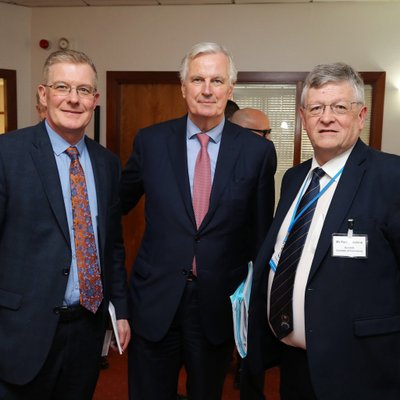
Paddy Malone FCA AITI
Paddy is the principal of Malone & Co. Chartered Accountants in Dundalk. A Fellow of Chartered Accountants Ireland and a Chartered Tax Consultant with the Irish Tax Institute, he has been advising businesses across County Louth and the North-East for over 35 years.