

Every year, accountants across Ireland produce thousands of profit and loss statements for their small business clients. And every year, a significant number of those clients look at the bottom line, ask “is that before or after tax?” and put the document in a drawer.
This is understandable. Accounting documents are not designed to be intuitively readable. They use terminology that is specific to the profession and a structure that reflects accounting standards rather than the way business owners naturally think about their business.
But the profit and loss statement — also called the income statement or P&L — contains information that should be driving real decisions about your business. Understanding what it says is a basic competency for any business owner, and it is one that takes thirty minutes to develop, not three years.
What the Profit and Loss Statement Is
The profit and loss statement shows all the income your business earned and all the costs it incurred over a specific period — usually a full financial year. The difference between the income and the costs is your profit or loss for that period.
It is a period document — it tells you what happened between two dates. This is different from the balance sheet, which is a point-in-time snapshot of what the business owns and owes.
For a sole trader, the profit figure is the figure on which you pay income tax. For a limited company, it is the figure on which corporation tax is calculated (with some adjustments for items treated differently for tax purposes). If you are unsure whether a limited company structure is right for you, our guide to sole trader vs limited company in Ireland covers the key differences.
The Structure of a Typical P&L
A profit and loss statement for a small Irish business typically follows this structure:
Revenue (Turnover). This is the total income generated from sales of goods or services before any deductions. It is the top line — the gross figure before any costs are removed. For a plumber, it is the total of all invoices issued. For a retailer, it is total sales. For a consultancy, it is total fees billed.
Cost of Sales (Direct Costs). These are the costs directly associated with delivering the product or service. For a trades business, this includes materials used on jobs and any subcontractor costs. For a retailer, it includes the purchase cost of goods sold. Cost of sales moves up and down directly with turnover — more sales generally means more direct costs.
Gross Profit. Revenue minus Cost of Sales. This is one of the most important numbers in the document.
Gross Profit = Revenue − Cost of Sales
The gross margin — gross profit expressed as a percentage of revenue — tells you how much of every euro of sales you retain after direct costs. If your revenue is €200,000 and your cost of sales is €120,000, your gross profit is €80,000 and your gross margin is 40%.
Monitoring gross margin over time is important. If it is declining — if you are retaining less of each sales euro after direct costs — it means either your prices are falling or your direct costs are rising, or both. This is a problem that the bottom line may obscure if overheads are being managed tightly.
Overheads (Indirect Costs / Operating Expenses). These are the costs of running the business that are not directly tied to specific sales — rent, telephone, insurance, accountancy fees, motor expenses, staff salaries, marketing. They are broadly fixed in the sense that they don’t automatically increase proportionally with sales volume.
Operating Profit (EBITDA or EBIT). Gross Profit minus Overheads gives you the operating profit. This is the profit from the core trading activity before interest charges and depreciation are taken into account. EBITDA (Earnings Before Interest, Tax, Depreciation, and Amortisation) is a commonly referenced version of this figure that strips out non-cash charges and financing costs to give a picture of the underlying operating cash generation.
Depreciation. Depreciation is the non-cash charge that allocates the cost of capital assets (equipment, vehicles, machinery) over their useful life. If you bought a van for €30,000 and it has a five-year useful life, the depreciation charge is €6,000 per year — reducing profit by €6,000 annually even though no cash is paid in that year.
Depreciation is a real cost — the van is genuinely losing value — but it does not represent a cash outflow in the year it is charged. This is why EBITDA is sometimes preferred as a measure of cash generation: it adds depreciation back to show profit before this non-cash charge.
Finance Costs. Interest on bank loans, overdrafts, or other borrowings is charged below the operating profit line. For many small businesses with no significant debt, this line is zero or minimal.
Profit Before Tax. Operating profit minus depreciation minus finance costs. This is the accounting profit on which corporation tax is calculated (with adjustments).
Tax. Corporation tax at 12.5% for trading companies (with adjustments for capital allowances, disallowable expenses, and other items).
Profit After Tax. The final bottom line — what belongs to the shareholders after all costs and taxes have been deducted.
What to Look For When Reading Your P&L
Once you understand the structure, the P&L becomes a diagnostic tool rather than just a compliance document.
Compare year on year. Is revenue growing? Is gross margin stable or declining? Are overheads growing faster than revenue? These trend comparisons tell you more than any single year in isolation.
Check the gross margin in detail. If your gross margin has dropped by 3–5 percentage points compared to last year, investigate why. Has the cost of materials increased? Have you taken on a number of loss-making jobs? Is there a category of work that is consistently less profitable than the rest?
Look at individual overhead lines. Which overhead categories have grown most? Is the growth justified by the corresponding revenue growth, or are costs creeping up without a business rationale?
Ask about the non-cash items. Depreciation, provisions, and accruals can significantly affect the profit figure. Understanding which costs are cash costs and which are accounting adjustments helps you reconcile the profit figure against the actual cash in your bank.
Look at the narrative, not just the numbers. Good management accounts — which I’d encourage every SME to have prepared quarterly, not just annually, as I explain in our guide to what a management accounts pack should contain — include a brief narrative explaining significant movements. The numbers tell you what happened; the narrative tells you why.
The Difference Between Profit and Cash
One of the most common confusions among business owners is the disconnect between reported profit and actual cash. A profitable business can run out of cash; a loss-making business can temporarily have plenty of it.
The P&L is an accruals-based document — it records income when it is earned and costs when they are incurred, not when cash changes hands. If you issue a large invoice in December and the customer pays in February, the revenue appears in December’s P&L but the cash arrives in February.
This is why the cash flow statement and the balance sheet (particularly debtors and creditors) matter as much as the P&L. A business that is profitable on paper but always struggling for cash typically has a working capital problem — slow-paying customers, fast-paying suppliers, or stock that sits too long.
Understanding your P&L in the context of your balance sheet and cash flow is the full picture. If you have only been looking at the bottom line of the P&L once a year, you are managing with a fraction of the financial information available to you. For more on getting your financial house in order, browse our accounting and compliance guides.
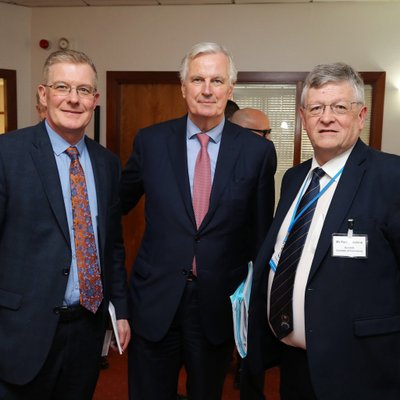
Paddy Malone FCA AITI
Paddy is the principal of Malone & Co. Chartered Accountants in Dundalk. A Fellow of Chartered Accountants Ireland and a Chartered Tax Consultant with the Irish Tax Institute, he has been advising businesses across County Louth and the North-East for over 35 years.